Tesla Plans Cybertruck Production Wind-Down as It Makes Room for Cybercab
Elon Musk says Tesla will wind down Cybertruck production at its Texas factory around mid-2027 to expand Cybercab output. The decision underscores a shift toward autonomy, but the truck’s ultimate fate and robotaxi economics remain unclear.
TickerCanvas Editorial ·
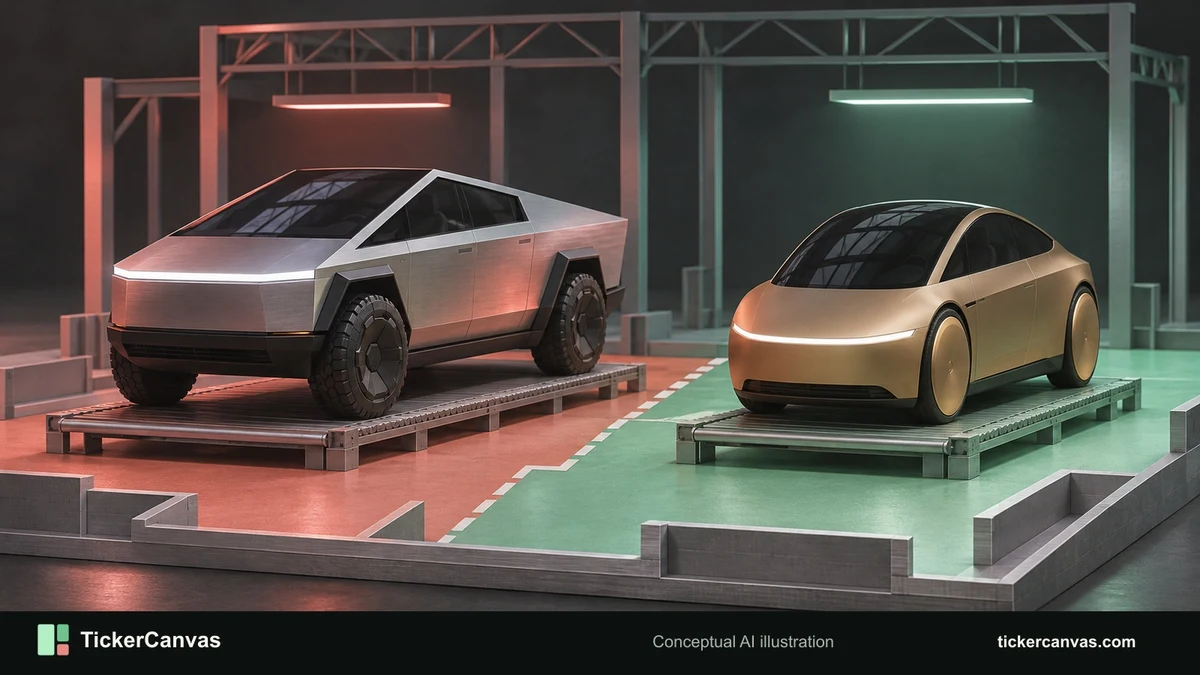
Tesla is preparing to wind down production of the Cybertruck at its Texas factory around the middle of 2027, shifting factory capacity toward its Cybercab autonomous-vehicle program. Chief Executive Elon Musk outlined the plan in a November 6, 2026 post on X, as reported by Reuters and the Associated Press. It is a consequential change in manufacturing priorities for an S&P 500 constituent that has increasingly asked investors to judge its future by autonomy as well as car sales.
What Tesla has—and has not—said
The immediate decision concerns Cybertruck production at the Texas plant. Musk said the space would be used to increase Cybercab output. He did not establish whether Cybertruck manufacturing would move to another site or disappear entirely, Reuters reported. Treating the announcement as a confirmed worldwide cancellation would go beyond the information disclosed.
The Cybertruck reached customers in late 2023 after years of publicity and delays. Its distinctive design attracted attention, but sales did not approach Musk's earlier ambition of roughly 250,000 vehicles annually. Citing Kelley Blue Book data, Reuters reported estimated U.S. Cybertruck sales of 20,237 units in 2025, versus 38,965 in 2024—a decline of about 48%. Those estimates are third-party retail-sales figures, not a Tesla disclosure of model-specific global deliveries.
The company’s own figures show a much smaller premium-vehicle category
Tesla's October 2, 2026 filing with the U.S. Securities and Exchange Commission reported 8,295 deliveries in its Other Models category for the third quarter of 2026, versus 15,933 in the same period a year earlier. That is a 48% year-over-year reduction for the category. Importantly, this line is not a Cybertruck-only sales report: it must not be presented as the number of Cybertrucks Tesla delivered.
The same filing recorded 478,237 Model 3/Y deliveries out of 486,532 total deliveries for the quarter. Those numbers illustrate the continued scale of Tesla's core passenger-car operations even as the company directs more of its strategic narrative toward autonomous mobility.
Why the Cybercab trade-off matters to investors
For shareholders, the key question is not simply whether one pickup survives. It is whether reallocating manufacturing space and engineering attention can produce a larger, economically sustainable business. Ending or relocating a lower-volume vehicle could free resources, but it does not by itself establish Cybercab demand, regulatory approval, production efficiency or profits.
Reuters reported that Tesla has begun limited paid Cybercab rides in Austin, while U.S. vehicle-safety regulators have been examining aspects of the program's certification. That makes the capacity shift a strategic intention rather than proof of a scaled, commercially proven robotaxi network. Both the timing and ultimate scope of the transition remain subject to execution and regulatory risk.
Tesla entered the S&P 500 in December 2020 and remains in the index's current constituent universe. Its change of direction therefore matters beyond individual Tesla shareholders: it is another high-profile example of how expectations about artificial intelligence and autonomy are shaping the investment case for a major U.S. equity-index company.
Bottom line: The Cybertruck wind-down is an announced manufacturing plan for mid-2027, not a completed shutdown. The unresolved issues are where—if anywhere—Cybertruck production continues and how successfully Cybercab can turn freed capacity into measurable business results.
TickerCanvas Editorial
Sources
- Reuters, Nov. 6, 2026 — Musk says Tesla will wind down Cybertruck production at Texas plant
- Associated Press, Nov. 6, 2026 — Cybertruck production plan, sales context and Tesla's strategic shift
- Tesla SEC Exhibit 99.1, Oct. 2, 2026 — Q3 2026 production and delivery figures
- S&P Dow Jones Indices, Dec. 11, 2020 — Tesla's S&P 500 addition effective Dec. 21, 2020
- Tesla SEC Exhibit 99.1, Oct. 22, 2025 — Q3 2025 operational summary; Other Models deliveries of 15,933
Information and market context, not investment advice. Market data on the canvas is shared and cached; read its actual session timestamp.
Explore the S&P 500 canvas