S&P 500 Falls 4.36% as All 11 Sectors Join AI-Led Rout
The S&P 500 lost 4.36% on November 5, its worst day since April 2025. Semiconductor shares led the decline, but every index sector finished lower as investors reassessed risks to AI data-center expansion.
TickerCanvas Editorial ·
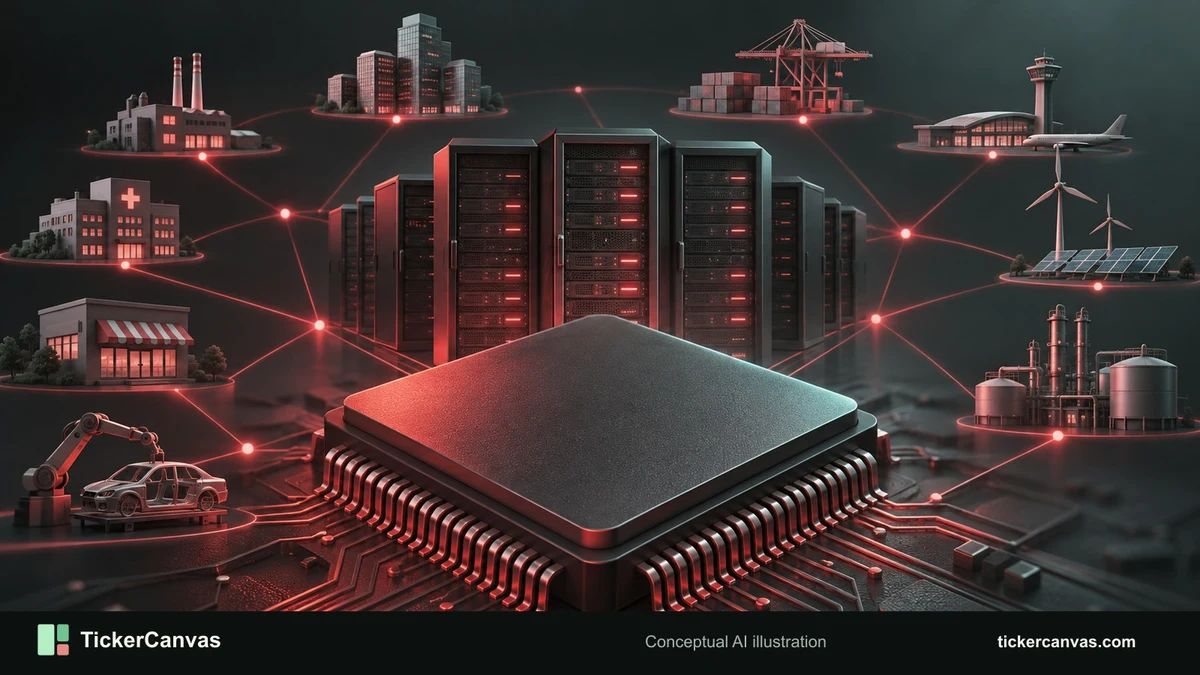
November 6, 2026 — Reporting on the completed U.S. trading session of Thursday, November 5.
According to Associated Press's November 5 closing-index report, the S&P 500 lost 4.36% on November 5, closing at 7,353.73—a decline of 334.89 points. It was the benchmark's steepest one-day percentage decline since April 2025. The selloff reversed more than the prior session's gain and turned a debate about artificial-intelligence spending into a broad market event.
The damage extended beyond technology
Technology supplied the sharpest pressure, but the decline was not confined to chipmakers. According to Reuters market commentary published on November 5, all 11 S&P 500 sectors ended lower. The index's information technology sector dropped approximately 7.3%, while the Philadelphia Semiconductor Index sank about 12%, a historically severe one-day loss. The Nasdaq Composite finished down 5.52%; the Dow Jones Industrial Average declined 3.44%.
Three S&P 500 chip constituents illustrate the scale of the move. TickerCanvas's shared historical snapshot for the November 5 session, compared with November 4, records Nvidia (NVDA) down 9.26%, Advanced Micro Devices (AMD) down 17.26%, and Micron Technology (MU) down 17.46%. These are end-of-day historical changes, not live quotes. The sectorwide selloff matters to an index weighted by market capitalization: sharp losses in large constituents can outweigh gains elsewhere.
What investors were reassessing
The immediate market debate concerned the pace and economics of new AI data centers. Following the November 3 U.S. midterm elections, investors confronted the possibility of greater scrutiny of proposed facilities, including local resistance over electricity costs and construction. Expensive financing and questions about whether infrastructure investment can earn sufficient returns were already part of that discussion. A slower buildout could eventually affect demand for processors, networking equipment, electricity infrastructure and related services.
That is a risk scenario, not a confirmed collapse in AI demand. The market decline does not prove that particular projects will be canceled, that new nationwide restrictions are in force, or that election outcomes alone caused every individual stock move. Earnings expectations, positioning and the valuations assigned to future growth can also change quickly.
What the next sessions must clarify
Investors now have two separate questions. First, how much proposed data-center capacity will actually be delayed by permitting, power availability or policy? Second, will reported orders, margins and cash flows justify the investment assumptions built into AI-linked share prices? Answers will emerge unevenly across companies; one day's index move cannot resolve them.
For readers tracking the S&P 500, November 5 was notable because a concentrated semiconductor shock coincided with declines across every sector. The closing figures above refer specifically to November 5, 2026 and should not be interpreted as prices or returns for November 6.
TickerCanvas Editorial
Sources
Information and market context, not investment advice. Market data on the canvas is shared and cached; read its actual session timestamp.
Explore the S&P 500 canvas