FAA's Four-Hour Ground Stop Leaves S&P 500 Airlines Facing Weekend Disruptions
A nationwide FAA departure halt on November 13 lasted more than four hours after communications failures. Flights resumed, but Delta, United and Southwest face operational disruption whose financial cost remains unknown.
TickerCanvas Editorial ·
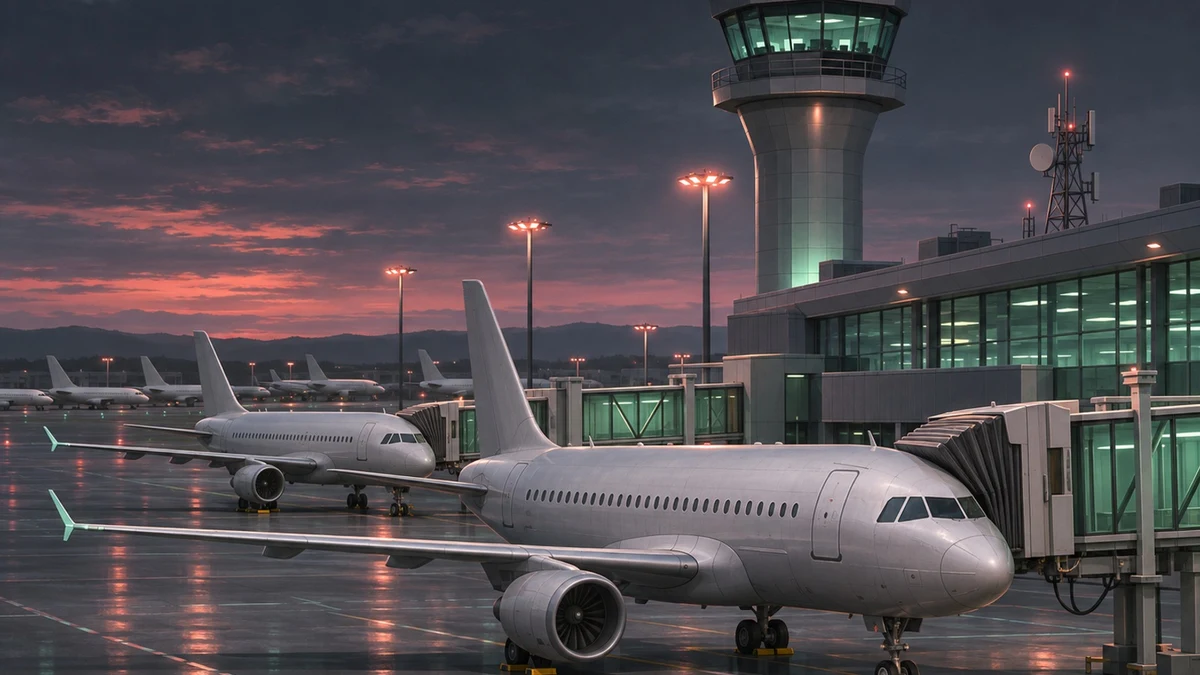
A safety decision that lasted just over four hours could take considerably longer to unwind for U.S. airlines. On Friday, November 13, 2026, the Federal Aviation Administration temporarily halted departures nationwide after telecommunications problems disrupted air-traffic-control communications and radar information. Transportation Secretary Sean Duffy said the restriction ended at 8:15 p.m. Eastern Time, but warned that getting aircraft and crews back into position would not be immediate.
What the FAA stopped—and when
The FAA said problems affected multiple Air Route Traffic Control Centers, the facilities responsible for coordinating aircraft between airports. The nationwide measure restricted departures; it did not mean every aircraft already airborne was ordered to land immediately or that all radar capability disappeared. In a November 13 briefing published by the Department of Transportation, Duffy said more than 3,500 planes were in the air when the stop was imposed and described controlled, safe arrivals as air traffic declined.
Duffy said the underlying instability began around 3:36 p.m. ET and involved intermittent communications and radar-data problems. He attributed the failures to older telecommunications equipment, including switches and routers that had become overloaded, while saying newer equipment had remained operational. That is the administration's preliminary account, not a completed independent investigation into every technical failure. The FAA itself called its initial account preliminary and subject to change.
The restriction was lifted at 8:15 p.m. ET Friday. Reopening departures is different from restoring the full flight schedule: a canceled flight, a misplaced aircraft or a crew that cannot legally operate its next assignment does not automatically become available when a nationwide stop ends.
Why airlines can feel a longer shock
Reuters reported late Friday that more than 4,700 flights had been canceled and roughly 10,000 delayed, citing the flight-tracking service FlightRadar24. Those are time-specific reported counts, not a final FAA audit, and disruption totals can change as the recovery continues. Flight cancellations and delays are also different measures and should not be added together to estimate unique passengers affected.
For airlines, the immediate operational challenges include rescheduling aircraft, replacing or repositioning crews, accommodating stranded passengers and adjusting connections. That can create expenses and interfere with revenue-producing flights, but there is not yet a reliable public accounting of the profit impact for any individual carrier. A nationwide event does not imply that each airline suffers the same proportion of disruption.
The S&P 500 connection: DAL, UAL and LUV
Delta Air Lines (DAL), United Airlines Holdings (UAL) and Southwest Airlines (LUV) are constituents in the S&P 500 universe used by TickerCanvas, verified against its November 13 cached constituent snapshot. Their business exposure makes this a material sector story, even though some other affected U.S. carriers are outside that index. The article is about the S&P 500 airline exposure, not a claim that every disrupted carrier belongs to the index.
Reuters reported airline stocks weakening around the late-session ground-stop announcement. Yet a market reaction is not a measurement of reimbursement costs, future bookings or quarterly earnings. The order came shortly before Friday's regular U.S. stock-market close, and the interruption continued into the evening. Extended-hours quotes, where available, are a separate session and should not be confused with official regular-session closing prices. This analysis makes no live-price claim and does not infer a specific cause for any individual stock move from prices alone.
What to watch next
The key next evidence will be the FAA's technical findings, the pace of airline schedule restoration and any quantified operational or financial effects disclosed by Delta, United or Southwest. The Department of Transportation said the air-traffic-control system has aging infrastructure and that the government is pursuing modernization, but the exact cause and future prevention measures require further evidence.
For investors watching the index, this is a reminder that a short-lived infrastructure interruption can have a longer commercial tail. Whether it changes any carrier's earnings outlook remains uncertain. TickerCanvas's S&P 500 market canvas uses dated shared snapshots; its tiles are not a live estimate of the costs of this incident.
TickerCanvas Editorial
Sources
- FAA — Statement on Nationwide Ground Stop, November 13, 2026
- U.S. Department of Transportation — Nationwide ground stop lifted; Duffy briefing, November 13, 2026
- Reuters via MarketScreener — U.S. lifts nationwide flight shutdown caused by communications failure, November 13, 2026
- Reuters — Stocks mostly ease with tech, Nvidia concerns; airline shares fall late in session, November 13, 2026
Information and market context, not investment advice. Market data on the canvas is shared and cached; read its actual session timestamp.
Explore the S&P 500 canvas